Death comes in many guises, but one way or another it is usually a lack of oxygen to the brain that delivers the coup de grâce. Whether as a result of a heart attack, drowning or suffocation, for example, people ultimately die because their neurons are deprived of oxygen, leading to cessation of electrical activity in the brain – the modern definition of biological death.
If the flow of freshly oxygenated blood to the brain is stopped, through whatever mechanism, people tend to have about 10 seconds before losing consciousness. They may take many more minutes to die, though, with the exact mode of death affecting the subtleties of the final experience.
…
Drowning
Typically, when a victim realises that they cannot keep their head above water they tend to panic, leading to the classic “surface struggle”. They gasp for air at the surface and hold their breath as they bob beneath, says Tipton. Struggling to breathe, they can’t call for help. Their bodies are upright, arms weakly grasping, as if trying to climb a non-existent ladder from the sea. Studies with New York lifeguards in the 1950s and 1960s found that this stage lasts just 20 to 60 seconds.
When victims eventually submerge, they hold their breath for as long as possible, typically 30 to 90 seconds. After that, they inhale some water, splutter, cough and inhale more. Water in the lungs blocks gas exchange in delicate tissues, while inhaling water also triggers the airway to seal shut – a reflex called a laryngospasm. “There is a feeling of tearing and a burning sensation in the chest as water goes down into the airway. Then that sort of slips into a feeling of calmness and tranquility,” says Tipton, describing reports from survivors.
That calmness represents the beginnings of the loss of consciousness from oxygen deprivation, which eventually results in the heart stopping and brain death.
Heart attack
…
The most common symptom is, of course, chest pain: a tightness, pressure or squeezing, often described as an “elephant on my chest”, which may be lasting or come and go. This is the heart muscle struggling and dying from oxygen deprivation. Pain can radiate to the jaw, throat, back, belly and arms. Other signs and symptoms include shortness of breath, nausea and cold sweats.
Most victims delay before seeking assistance, waiting an average of 2 to 6 hours. Women are the worst, probably because they are more likely to experience less well-known symptoms, such as breathlessness, back or jaw pain, or nausea, says JoAnn Manson, an epidemiologist at Harvard Medical School.
…
Even small heart attacks can play havoc with the electrical impulses that control heart muscle contraction, effectively stopping it. In about 10 seconds the person loses consciousness, and minutes later they are dead.
Bleeding to death
People can bleed to death in seconds if the aorta, the major blood vessel leading from the heart, is completely severed, for example, after a severe fall or car accident.
Death could creep up much more slowly if a smaller vein or artery is nicked – even taking hours. Such victims would experience several stages of haemorrhagic shock. The average adult has 5 litres of blood. Losses of around 750 millilitres generally cause few symptoms. Anyone losing 1.5 litres – either through an external wound or internal bleeding – feels weak, thirsty and anxious, and would be breathing fast. By 2 litres, people experience dizziness, confusion and then eventual unconsciousness.
Fire
Long the fate of witches and heretics, burning to death is torture. Hot smoke and flames singe eyebrows and hair and burn the throat and airways, making it hard to breathe. Burns inflict immediate and intense pain through stimulation of the nociceptors – the pain nerves in the skin. To make matters worse, burns also trigger a rapid inflammatory response, which boosts sensitivity to pain in the injured tissues and surrounding areas.
…
Most people who die in fires do not in fact die from burns. The most common cause of death is inhaling toxic gases – carbon monoxide, carbon dioxide and even hydrogen cyanide – together with the suffocating lack of oxygen. One study of fire deaths in Norway from 1996 found that almost 75 per cent of the 286 people autopsied had died from carbon monoxide poisoning.
Depending on the size of the fire and how close you are to it, concentrations of carbon monoxide could start to cause headache and drowsiness in minutes, eventually leading to unconsciousness. According to the US National Fire Protection Association, 40 per cent of the victims of fatal home fires are knocked out by fumes before they can even wake up.
Decaptitation
Beheading, if somewhat gruesome, can be one of the quickest and least painful ways to die – so long as the executioner is skilled, his blade sharp, and the condemned sits still.
…
Quick it may be, but consciousness is nevertheless believed to continue after the spinal chord is severed. A study in rats in 1991 found that it takes 2.7 seconds for the brain to consume the oxygen from the blood in the head; the equivalent figure for humans has been calculated at 7 seconds.
…
It took the axeman three attempts to sever the head of Mary Queen of Scots in 1587. He had to finish the job with a knife.
Decades earlier in 1541, Margaret Pole, the Countess of Salisbury, was executed at the Tower of London. She was dragged to the block, but refused to lay her head down. The inexperienced axe man made a gash in her shoulder rather than her neck. According to some reports, she leapt from the block and was chased by the executioner, who struck 11 times before she died.
Electrocution
In accidental electrocutions, usually involving low, household current, the most common cause of death is arrhythmia, stopping the heart dead. Unconsciousness ensues after the standard 10 seconds, says Richard Trohman, a cardiologist at Rush University in Chicago. One study of electrocution deaths in Montreal, Canada found that 92 per cent had probably died from arrhythmia.
Higher currents can produce nearly immediate unconsciousness.
…
Fall from a height
A high fall is certainly among the speediest ways to die: terminal velocity (no pun intended) is about 200 kilometres per hour, achieved from a height of about 145 metres or more. A study of deadly falls in Hamburg, Germany, found that 75 per cent of victims died in the first few seconds or minutes after landing.
The exact cause of death varies, depending on the landing surface and the person’s posture. People are especially unlikely to arrive at the hospital alive if they land on their head – more common for shorter (under 10 metres) and higher (over 25 metres) falls. A 1981 analysis of 100 suicidal jumps from the Golden Gate Bridge in San Francisco – height: 75 metres, velocity on impact with the water: 120 kilometres per hour – found numerous causes of instantaneous death including massive lung bruising, collapsed lungs, exploded hearts or damage to major blood vessels and lungs through broken ribs.
Survivors of great falls often report the sensation of time slowing down. The natural reaction is to struggle to maintain a feet-first landing, resulting in fractures to the leg bones, lower spinal column and life-threatening broken pelvises. The impact travelling up through the body can also burst the aorta and heart chambers. Yet this is probably still the safest way to land, despite the force being concentrated in a small area: the feet and legs form a “crumple zone” which provides some protection to the major internal organs.
Some experienced climbers or skydivers who have survived a fall report feeling focused, alert and driven to ensure they landed in the best way possible: relaxed, legs bent and, where possible, ready to roll.
…
Hanging
Suicides and old-fashioned “short drop” executions cause death by strangulation; the rope puts pressure on the windpipe and the arteries to the brain. This can cause unconsciousness in 10 seconds, but it takes longer if the noose is incorrectly sited. Witnesses of public hangings often reported victims “dancing” in pain at the end of the rope, struggling violently as they asphyxiated. Death only ensues after many minutes, as shown by the numerous people being resuscitated after being cut down – even after 15 minutes.
When public executions were outlawed in Britain in 1868, hangmen looked for a less performance-oriented approach. They eventually adopted the “long-drop” method, using a lengthier rope so the victim reached a speed that broke their necks. It had to be tailored to the victim’s weight, however, as too great a force could rip the head clean off, a professionally embarrassing outcome for the hangman.
Despite the public boasting of several prominent executioners in late 19th-century Britain, a 1992 analysis of the remains of 34 prisoners found that in only about half of cases was the cause of death wholly or partly due to spinal trauma. Just one-fifth showed the classic “hangman’s fracture” between the second and third cervical vertebrae. The others died in part from asphyxiation.
…
Lethal injection
Read full article
Continue reading page |1 |2 |3 |4
Michael Spence, an anthropologist at the University of Western Ontario in London, Canada, has found similar results in US victims. He concluded, however, that even if asphyxiation played a role, the trauma of the drop would have rapidly rendered all of them unconscious. “What the hangmen were looking for was quick cessation of activity,” he says. “And they knew enough about their craft to ensure that happened. The thing they feared most was decapitation.”
Lethal injection
US-government approved, but is it really painless?
Lethal injection was designed in Oklahoma in 1977 as a humane alternative to the electric chair. The state medical examiner and chair of anaesthesiology settled on a series of three drug injections. First comes the anaesthetic thiopental to speed away any feelings of pain, followed by a paralytic agent called pancuronium to stop breathing. Finally potassium chloride is injected, which stops the heart almost instantly.
Each drug is supposed to be administered in a lethal dose, a redundancy to ensure speedy and humane death. However, eyewitnesses have reported inmates convulsing, heaving and attempting to sit up during the procedure, suggesting the cocktail is not always completely effective.
…
Explosive decompression
In real life there has been just one fatal space depressurisation accident. This occurred on the Russian Soyuz-11 mission in 1971, when a seal leaked upon re-entry into the Earth’s atmosphere; upon landing all three flight crew were found dead from asphyxiation.
Most of our knowledge of depressurisation comes from animal experiments and the experiences of pilots in accidents at very high altitudes. When the external air pressure suddenly drops, the air in the lungs expands, tearing the fragile gas exchange tissues. This is especially damaging if the victim neglects to exhale prior to decompression or tries to hold their breath. Oxygen begins to escape from the blood and lungs.
Experiments on dogs in the 1950s showed that 30 to 40 seconds after the pressure drops, their bodies began to swell as the water in tissues vaporised, though the tight seal of their skin prevented them from “bursting”. The heart rate rises initially, then plummets. Bubbles of water vapour form in the blood and travel through the circulatory system, obstructing blood flow. After about a minute, blood effectively stops circulating.
Human survivors of rapid decompression accidents include pilots whose planes lost pressure, or in one case a NASA technician who accidentally depressurised his flight suit inside a vacuum chamber. They often report an initial pain, like being hit in the chest, and may remember feeling air escape from their lungs and the inability to inhale. Time to the loss of consciousness was generally less than 15 seconds.
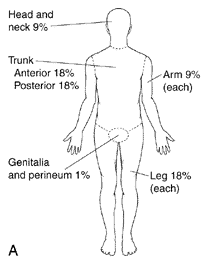 In the 1950s, doctors developed an easy way to estimate the ratio of the area of a patient’s burns to the total area of his skin. The system works by assigning standard percentages to major body parts. (Most of these happen to be multiples of nine.) The skin on each arm, for example, covers 9 percent of a patient’s total surface area. Each leg comprises 18 percent, as do the front and back of the torso. The head and neck together make up another 9 percent, and the last bit (or 1 percent) covers the genitalia and perineum. This breakdown makes it easy for doctors to estimate the size of a burn in relation to a body—a burn that covered half the arm would add 4 or 5 percent to the total figure. …