A big benefit of open source: better learning & teaching
From Jon Udell’s “Open source education” (InfoWorld: 7 June 2006):
Open source software development, to a degree unmatched by any other modern profession, offers apprentices the opportunity to watch journeymen and masters at work, to interact with them, and to learn how they think, work, succeed, and fail. Transparency and accountability govern not only the production of source code but also the companion processes of design, specification, testing, maintenance, and evaluation. …
It’s typical of many professions to cultivate an aura of infallibility and monopoly control of information. Open source doesn’t work that way. There are prima donnas, to be sure, but the culture requires practitioners to show their cards, and it erodes information monopolies. Shared code is just the tip of the iceberg. Below the waterline, there’s a vast body of shared knowledge and tradition, grounded in what Tim O’Reilly calls an architecture of participation.
We’ve come to see open source as an economic innovation. Cooperative production of commodity infrastructure paves the way for competitive production of high-value products and services. Perhaps we’ll someday see open source as an educational innovation, too. Cooperative production of shared knowledge isn’t just a by-product. When apprentices, journeymen, and masters engage in a continuous cycle of learning and teaching, an old approach to education is made new again.
A big benefit of open source: better learning & teaching Read More »
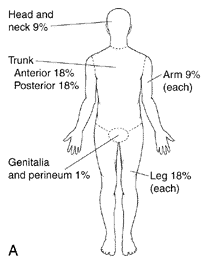 In the 1950s, doctors developed an easy way to estimate the ratio of the area of a patient’s burns to the total area of his skin. The system works by assigning standard percentages to major body parts. (Most of these happen to be multiples of nine.) The skin on each arm, for example, covers 9 percent of a patient’s total surface area. Each leg comprises 18 percent, as do the front and back of the torso. The head and neck together make up another 9 percent, and the last bit (or 1 percent) covers the genitalia and perineum. This breakdown makes it easy for doctors to estimate the size of a burn in relation to a body—a burn that covered half the arm would add 4 or 5 percent to the total figure. …