2011

Speaking at SLUUG: Amazing, Stupendous, Mind-Blowing Apps for iPad2

Jans Carton & I are delivering a talk at the St. Louis UNIX Users Group at 6:30 pm this Wednesday, 8 June 2011, titled “Amazing, Stupendous, Mind-Blowing Apps for iPad2”. We’ll be demoing iPad apps live for everyone. If you want to find out more about the iPad, or discover some awesome new iPad apps, then come hear Jans & I speak.

Here’s the complete description:

It’s becoming crystal clear that tablets and other mobile devices are leading the computing revolution into the next decade, and at the forefront (at least for now) is Apple’s iPad. Scott Granneman & Jans Carton will demonstrate iPad apps that they find particularly useful, cool, or amazing – sometimes all three at the same time! You’ll see apps for everything from video to games to reading to productivity, and much, much more. We guarantee you’ll see something that makes you think, and something else that makes you go “Wow!”.

The meeting will be held at Graybar Electric Co., Inc. at 11885 Lackland Road, 63146. Directions are at http://sluug.org/resources/meeting_info/map_graybar.shtml, & a Google Map can be found at http://goo.gl/maps/jnpX.

Speaking at SLUUG: Amazing, Stupendous, Mind-Blowing Apps for iPad2 Read More »
Saul Bass changed how audiences view movie credits

From Christian Annyas’s “Saul Bass Title Sequences“:

“PROJECTIONISTS – PULL CURTAIN BEFORE TITLES”.

This is the text of a note that was stuck on the cans when the reels of film for “The Man With the Golden Arm” arrived at US movie theatres in 1955.

Until then the credits were referred to as ‘popcorn time.’ Audiences resented them and projectionists only pulled back the curtains to reveal the screen once they’d finished.
Saul Bass’ powerful title sequence for “The Man With the Golden Arm” changed the way directors and designers would treat the opening titles.

“For the average audience, the credits tell them there’s only three minutes left to eat popcorn. I take this ‘dead’ period and try to do more than simply get rid of names that filmgoers aren’t interested in. I aim to set up the audience for what’s coming; make them expectant.” — SAUL BASS

Saul Bass changed how audiences view movie credits Read More »

The Pareto Principle & Temperament Dimensions

From David Brooks’ “More Tools For Thinking” (The New York Times: 29 March 2011):

Clay Shirkey nominates the Pareto Principle. We have the idea in our heads that most distributions fall along a bell curve (most people are in the middle). But this is not how the world is organized in sphere after sphere. The top 1 percent of the population control 35 percent of the wealth. The top two percent of Twitter users send 60 percent of the messages. The top 20 percent of workers in any company will produce a disproportionate share of the value. Shirkey points out that these distributions are regarded as anomalies. They are not.

Helen Fisher, the great researcher into love and romance, has a provocative entry on “temperament dimensions.” She writes that we have four broad temperament constellations. One, built around the dopamine system, regulates enthusiasm for risk. A second, structured around the serotonin system, regulates sociability. A third, organized around the prenatal testosterone system, regulates attention to detail and aggressiveness. A fourth, organized around the estrogen and oxytocin systems, regulates empathy and verbal fluency.

This is an interesting schema to explain temperament. It would be interesting to see others in the field evaluate whether this is the best way to organize our thinking about our permanent natures.

The Pareto Principle & Temperament Dimensions Read More »

Some great gross parasites

Parasitoid Wasps

From Charles Q. Choi’s “Web-manipulating wasps” (Live Science: 2 March 2011):

Although parasites harm their hosts, they don’t usually kill them, if only to keep themselves alive. Not so with parasitoids, which ultimately destroy and often consume their hosts. Parasitoid wasps, which inspired the monster in the movie “Alien,” lay their eggs inside their victims, with the offspring eventually devouring their way out. A number of the species control their host’s minds in extraordinary ways — the larvae of the wasp Hymenoepimecis argyraphaga, which infests the spider Plesiometa argyra, makes their victims spin unusual webs especially well-suited for supporting their cocoons.

From Charles Q. Choi’s “Male-killing bacteria” (Live Science: 2 March 2011):

The genus of bacteria known as Wolbachia infests a whopping 70 percent of the world’s invertebrates, and has evolved devious strategies to keep spreading. In female hosts, the germ can hitch a ride to the next generation aboard the mother’s eggs, and since males are essentially useless for the bacteria’s survival, the parasite often eliminates them to increase the rate of females born, by either killing male embryos outright or turning them into females.

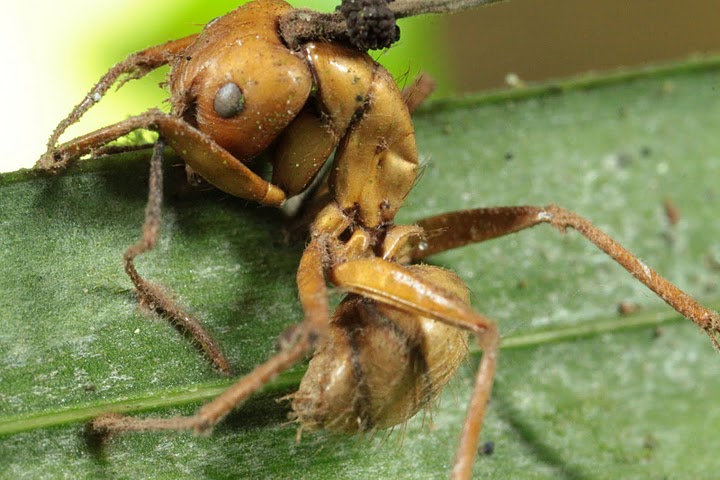
From Charles Q. Choi’s “Head-bursting fungus” (Live Science: 2 March 2011):

Dead ant zombified by fungus

Credit: David P. Hughes

In a bizarre death sentence, the fungus Ophiocordyceps unilateralis turns carpenter ants into the walking dead. The fungus prefers the undersides of leaves of plants growing on the forest floor. That’s where temperature, humidity and sunlight are ideal for the fungus to grow and reproduce and infect more victims. The parasite gets the insects to die hanging upside down, and then erupts a long stalk from their heads with which it sprinkle its spores to other ants. Fossil evidence recently suggested this fungus has zombified ants for millions of years.

From Charles Q. Choi’s “Tongue-eating crustacean” (Live Science: 2 March 2011):

The crustacean Cymothoa exigua has the dubious and unsettling honor of being the only parasite known to replace an organ. It enters through the gills of the spotted rose snapper, attaching to the base of the fish’s tongue, where it drinks its blood. The bloodsucking causes the tongue to eventually wither away, at which point the crustacean attaches itself to the tongue stub, acting as the fish’s tongue from then on.

Some great gross parasites Read More »