2009

Could Green Dam lead to the largest botnet in history?

Green_Damn_site_blocked.jpg

From Rob Cottingham’s “From blocking to botnet: Censorship isn’t the only problem with China’s new Internet blocking software” (Social Signal: 10 June 2009):

Any blocking software needs to update itself from time to time: at the very least to freshen its database of forbidden content, and more than likely to fix bugs, add features and improve performance. (Most anti-virus software does this.)

If all the software does is to refresh the list of banned sites, that limits the potential for abuse. But if the software is loading new executable code onto the computer, suddenly there’s the potential for something a lot bigger.

Say you’re a high-ranking official in the Chinese military. And let’s say you have some responsibility for the state’s capacity to wage so-called cyber warfare: digital assaults on an enemy’s technological infrastructure.

It strikes you: there’s a single backdoor into more that 40 million Chinese computers, capable of installing… well, nearly anything you want.

What if you used that backdoor, not just to update blocking software, but to create something else?

Say, the biggest botnet in history?

Still, a botnet 40 million strong (plus the installed base already in place in Chinese schools and other institutions) at the beck and call of the military is potentially a formidable weapon. Even if the Chinese government has no intention today of using Green Dam for anything other than blocking pornography, the temptation to repurpose it for military purposes may prove to be overwhelming.

Could Green Dam lead to the largest botnet in history? Read More »

Green Dam is easily exploitable

Green_Damn_site_blocked.jpg

From Scott Wolchok, Randy Yao, and J. Alex Halderman’s “Analysis of the Green Dam Censorware System” (The University of Michigan: 11 June 2009):

We have discovered remotely-exploitable vulnerabilities in Green Dam, the censorship software reportedly mandated by the Chinese government. Any web site a Green Dam user visits can take control of the PC.

According to press reports, China will soon require all PCs sold in the country to include Green Dam. This software monitors web sites visited and other activity on the computer and blocks adult content as well as politically sensitive material.

We examined the Green Dam software and found that it contains serious security vulnerabilities due to programming errors. Once Green Dam is installed, any web site the user visits can exploit these problems to take control of the computer. This could allow malicious sites to steal private data, send spam, or enlist the computer in a botnet. In addition, we found vulnerabilities in the way Green Dam processes blacklist updates that could allow the software makers or others to install malicious code during the update process.

We found these problems with less than 12 hours of testing, and we believe they may be only the tip of the iceberg. Green Dam makes frequent use of unsafe and outdated programming practices that likely introduce numerous other vulnerabilities. Correcting these problems will require extensive changes to the software and careful retesting. In the meantime, we recommend that users protect themselves by uninstalling Green Dam immediately.

Green Dam is easily exploitable Read More »

The limitations of Windows 7 on netbooks

From Farhad Manjoo’s “I, for One, Welcome Our New Android Overlords” (Slate: 5 June 2008):

Microsoft promises that Windows 7 will be able to run on netbooks, but it has announced a risky strategy to squeeze profits from these machines. The company plans to cripple the cheapest versions of the new OS in order to encourage PC makers to pay for premium editions. If you buy a netbook that comes with the low-priced Windows 7 Starter Edition, you won’t be able to change your screen’s background or window colors, you won’t be able to play DVDs, you can’t connect it to another monitor, and you won’t see many of the user-interface advances found in other versions. If you’d like more flexibility, you’ll need to upgrade to a more expensive version of Windows—which will, of course, defeat the purpose of your cheap PC. (Microsoft had originally planned to limit Starter Edition even further—you wouldn’t be able to run more than three programs at a time. It removed that limitation after howls of protest.)

The limitations of Windows 7 on netbooks Read More »

Meeting expectations, no matter how silly, in design

From Operator No. 9’s “That decorating touch” (Interactive Week: 24 April 2000): 100:

Intel AnyPoint Wireless:

Dan Sweeney, general manager of Intel’s Home Networking division, says that when the company showed consumer focus groups the AnyPoint Wireless home networking system …, people became very confused, because there wasn’t a visible antenna. The desktop version of the wireless adapter — about the size of a deck of cards — has an antenna hidden inside it. ‘They looked at it and said, “That’s not a radio!”‘ Sweeney says. So Intel’s industrial designers added a tiny little plastic tip on top of the unit that is supposed to resemble an antenna. It actually looks — and I’m sure this was not intended by the designers — kind of like the type of hat klansmen or maybe religious leaders — bishops? vicars? — wear. Then again, maybe I just need to get out more often.

Meeting expectations, no matter how silly, in design Read More »

The Uncanny Valley, art forgery, & love

Apply new wax to old wood
Creative Commons License photo credit: hans s

From Errol Morris’ “Bamboozling Ourselves (Part 2)” (The New York Times: 28 May 2009):

[Errol Morris:] The Uncanny Valley is a concept developed by the Japanese robot scientist Masahiro Mori. It concerns the design of humanoid robots. Mori’s theory is relatively simple. We tend to reject robots that look too much like people. Slight discrepancies and incongruities between what we look like and what they look like disturb us. The closer a robot resembles a human, the more critical we become, the more sensitive to slight discrepancies, variations, imperfections. However, if we go far enough away from the humanoid, then we much more readily accept the robot as being like us. This accounts for the success of so many movie robots — from R2-D2 to WALL-E. They act like humans but they don’t look like humans. There is a region of acceptability — the peaks around The Uncanny Valley, the zone of acceptability that includes completely human and sort of human but not too human. The existence of The Uncanny Valley also suggests that we are programmed by natural selection to scrutinize the behavior and appearance of others. Survival no doubt depends on such an innate ability.

EDWARD DOLNICK: [The art forger Van Meegeren] wants to avoid it. So his big challenge is he wants to paint a picture that other people are going to take as Vermeer, because Vermeer is a brand name, because Vermeer is going to bring him lots of money, if he can get away with it, but he can’t paint a Vermeer. He doesn’t have that skill. So how is he going to paint a picture that doesn’t look like a Vermeer, but that people are going to say, “Oh! It’s a Vermeer?” How’s he going to pull it off? It’s a tough challenge. Now here’s the point of The Uncanny Valley: as your imitation gets closer and closer to the real thing, people think, “Good, good, good!” — but then when it’s very close, when it’s within 1 percent or something, instead of focusing on the 99 percent that is done well, they focus on the 1 percent that you’re missing, and you’re in trouble. Big trouble.

Van Meegeren is trapped in the valley. If he tries for the close copy, an almost exact copy, he’s going to fall short. He’s going to look silly. So what he does instead is rely on the blanks in Vermeer’s career, because hardly anything is known about him; he’s like Shakespeare in that regard. He’ll take advantage of those blanks by inventing a whole new era in Vermeer’s career. No one knows what he was up to all this time. He’ll throw in some Vermeer touches, including a signature, so that people who look at it will be led to think, “Yes, this is a Vermeer.”

Van Meegeren was sometimes careful, other times astonishingly reckless. He could have passed certain tests. What was peculiar, and what was quite startling to me, is that it turned out that nobody ever did any scientific test on Van Meegeren, even the stuff that was available in his day, until after he confessed. And to this day, people hardly ever test pictures, even multi-million dollar ones. And I was so surprised by that that I kept asking, over and over again: why? Why would that be? Before you buy a house, you have someone go through it for termites and the rest. How could it be that when you’re going to lay out $10 million for a painting, you don’t test it beforehand? And the answer is that you don’t test it because, at the point of being about to buy it, you’re in love! You’ve found something. It’s going to be the high mark of your collection; it’s going to be the making of you as a collector. You finally found this great thing. It’s available, and you want it. You want it to be real. You don’t want to have someone let you down by telling you that the painting isn’t what you think it is. It’s like being newly in love. Everything is candlelight and wine. Nobody hires a private detective at that point. It’s only years down the road when things have gone wrong that you say, “What was I thinking? What’s going on here?” The collector and the forger are in cahoots. The forger wants the collector to snap it up, and the collector wants it to be real. You are on the same side. You think that it would be a game of chess or something, you against him. “Has he got the paint right?” “Has he got the canvas?” You’re going to make this checkmark and that checkmark to see if the painting measures up. But instead, both sides are rooting for this thing to be real. If it is real, then you’ve got a masterpiece. If it’s not real, then today is just like yesterday. You’re back where you started, still on the prowl.

The Uncanny Valley, art forgery, & love Read More »

Taxi driver party lines

8th Ave .....Midtown Manhattan
Creative Commons License photo credit: 708718

From Annie Karni’s “Gabbing Taxi Drivers Talking on ‘Party Lines’” (The New York Sun: 11 January 2007):

It’s not just wives at home or relatives overseas that keep taxi drivers tied up on their cellular phones during work shifts. Many cabbies say that when they are chatting on duty, it’s often with their cab driver colleagues on group party lines. Taxi drivers say they use conference calls to discuss directions and find out about congested routes to avoid. They come to depend on one another as first responders, reacting faster even than police to calls from drivers in distress. Some drivers say they participate in group prayers on a party line.

It is during this morning routine, waiting for the first shuttle flights to arrive from Washington and Boston, where many friendships between cabbies are forged and cell phone numbers are exchanged, Mr. Sverdlov said. Once drivers have each other’s numbers, they can use push-to-talk technology to call large groups all at once.

Mr. Sverdlov said he conferences with up to 10 cabbies at a time to discuss “traffic, what’s going on, this and that, and where do cops stay.” He estimated that every month, he logs about 20,000 talking minutes on his cell phone.

While civilian drivers are allowed to use hands-free devices to talk on cell phones while behind the wheel, the Taxi & Limousine Commission imposed a total cell phone ban for taxi drivers on duty in 1999. In 2006, the Taxi & Limousine Commission issued 1,049 summonses for phone use while on duty, up by almost 69% from the 621 summonses it issued the previous year. Drivers caught chatting while driving are fined $200 and receive two-point penalties on their licenses.

Drivers originally from countries like Israel, China, and America, who are few and far between, say they rarely chat on the phone with other cab drivers because of the language barrier. For many South Asians and Russian drivers, however, conference calls that are prohibited by the Taxi & Limousine Commission are mainstays of cabby life.

Taxi driver party lines Read More »

David Foster Wallace on rock, the rise of mass media, & the generation gap

From Larry McCaffery’s “Conversation with David Foster Wallace” (Dalkey Archive Press at the University of Illinois: Summer 1993):

Rock music itself bores me, usually. The phenomenon of rock interests me, though, because its birth was part of the rise of popular media, which completely changed the ways the U.S. was unified and split. The mass media unified the country geographically for pretty much the first time. Rock helped change the fundamental splits in the U.S. from geographical splits to generational ones. Very few people I talk to understand what “generation gap” ‘s implications really were. Kids loved rock partly because their parents didn’t, and obversely. In a mass mediated nation, it’s no longer North vs. South. It’s under-thirty vs. over thirty. I don’t think you can understand the sixties and Vietnam and love ins and LSD and the whole era of patricidal rebellion that helped inspire early postmodern fiction’s whole “We’re-going-to-trash-your-Beaver Cleaver-plasticized-G.O.P.-image-of-life-in-America” attitude without understanding rock ‘n roll. Because rock was and is all about busting loose, exceeding limits, and limits are usually set by parents, ancestors, older authorities.

David Foster Wallace on rock, the rise of mass media, & the generation gap Read More »

David Foster Wallace on minimalism & metafiction

From Larry McCaffery’s “Conversation with David Foster Wallace” (Dalkey Archive Press at the University of Illinois: Summer 1993):

Minimalism’s just the other side of metafictional recursion. The basic problem’s still the one of the mediating narrative consciousness. Both minimalism and metafiction try to resolve the problem in radical ways. Opposed, but both so extreme they end up empty. Recursive metafiction worships the narrative consciousness, makes “it” the subject of the text. Minimalism’s even worse, emptier, because it’s a fraud: it eschews not only self-reference but any narrative personality at all, tries to pretend there “is” no narrative consciousness in its text. This is so fucking American, man: either make something your God and cosmos and then worship it, or else kill it.

David Foster Wallace on minimalism & metafiction Read More »

David Foster Wallace on the familiar & the strange

From Larry McCaffery’s “Conversation with David Foster Wallace” (Dalkey Archive Press at the University of Illinois: Summer 1993):

If you mean a post-industrial, mediated world, it’s inverted one of fiction’s big historical functions, that of providing data on distant cultures and persons. The first real generalization of human experience that novels tried to accomplish. If you lived in Bumfuck, Iowa, a hundred years ago and had no idea what life was like in India, good old Kipling goes over and presents it to you. … Well, but fiction’s presenting function for today’s reader has been reversed: since the whole global village is now presented as familiar, electronically immediate—satellites, microwaves, intrepid PBS anthropologists, Paul Simon’s Zulu back-ups—it’s almost like we need fiction writers to restore strange things’ ineluctable “strangeness,” to defamiliarize stuff, I guess you’d say.

… For our generation, the entire world seems to present itself as “familiar,” but since that’s of course an illusion in terms of anything really important about people, maybe any “realistic” fiction’s job is opposite what it used to be—no longer making the strange familiar but making the familiar strange again. It seems important to find ways of reminding ourselves that most “familiarity” is meditated and delusive.

David Foster Wallace on the familiar & the strange Read More »

David Foster Wallace on TV, loneliness, & death

From Larry McCaffery’s “Conversation with David Foster Wallace” (Dalkey Archive Press at the University of Illinois: Summer 1993):

One thing TV does is help us deny that we’re lonely. With televised images, we can have the facsimile of a relationship without the work of a real relationship. It’s an anesthesia of “form.” The interesting thing is why we’re so desperate for this anesthetic against loneliness. You don’t have to think very hard to realize that our dread of both relationships and loneliness, both of which are like sub-dreads of our dread of being trapped inside a self (a psychic self, not just a physical self), has to do with angst about death, the recognition that I’m going to die, and die very much alone, and the rest of the world is going to go merrily on without me.

David Foster Wallace on TV, loneliness, & death Read More »

David Foster Wallace on fiction’s purpose in dark times

From Larry McCaffery’s “Conversation with David Foster Wallace” (Dalkey Archive Press at the University of Illinois: Summer 1993):

Look man, we’d probably most of us agree that these are dark times, and stupid ones, but do we need fiction that does nothing but dramatize how dark and stupid everything is? In dark times, the definition of good art would seem to be art that locates and applies CPR to those elements of what’s human and magical that still live and glow despite the times’ darkness. Really good fiction could have as dark a worldview as it wished, but it’d find a way both to depict this world and to illuminate the possibilities for being alive and human in it.

David Foster Wallace on fiction’s purpose in dark times Read More »

Avoid toxic people

From Milton Glaser’s “Ten Things I Have Learned” (Milton Glaser: 22 November 2001):

… the important thing that I can tell you is that there is a test to determine whether someone is toxic or nourishing in your relationship with them. Here is the test: You have spent some time with this person, either you have a drink or go for dinner or you go to a ball game. It doesn’t matter very much but at the end of that time you observe whether you are more energised or less energised. Whether you are tired or whether you are exhilarated. If you are more tired then you have been poisoned. If you have more energy you have been nourished. The test is almost infallible and I suggest that you use it for the rest of your life.

Avoid toxic people Read More »

Al Qaeda’s use of social networking sites

From Brian Prince’s “How Terrorism Touches the ‘Cloud’ at RSA” (eWeek: 23 April 2009):

When it comes to the war on terrorism, not all battles, intelligence gathering and recruitment happen in the street. Some of it occurs in the more elusive world of the Internet, where supporters of terrorist networks build social networking sites to recruit and spread their message.  
Enter Jeff Bardin of Treadstone 71, a former code breaker, Arabic translator and U.S. military officer who has been keeping track of vBulletin-powered sites run by supporters of al Qaeda. There are between 15 and 20 main sites, he said, which are used by terrorist groups for everything from recruitment to the distribution of violent videos of beheadings.

… “One social networking site has over 200,000 participants. …

The videos on the sites are produced online by a company called “As-Sahab Media” (As-Sahab means “the cloud” in English). Once shot, the videos make their way from hideouts to the rest of the world via a system of couriers. Some of them contain images of violence; others exhortations from terrorist leaders. Also on the sites are tools such as versions of “Mujahideen Secrets,” which is used for encryption.

“It’s a pretty solid tool; it’s not so much that the tool is so much different from the new PGP-type [tool], but the fact is they built it from scratch, which shows a very mature software development lifecycle,” he said.

Al Qaeda’s use of social networking sites Read More »

The watchclock knows where your night watchman is

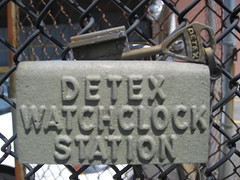
Detex Watchclock Station
Creative Commons License photo credit: 917press

From Christopher Fahey’s “Who Watches the Watchman?” (GraphPaper: 2 May 2009):

The Detex Newman watchclock was first introduced in 1927 and is still in wide use today.

&hellip What could you possibly do in 1900 to be absolutely sure a night watchman was making his full patrol?

An elegant solution, designed and patented in 1901 by the German engineer A.A. Newman, is called the “watchclock”. It’s an ingenious mechanical device, slung over the shoulder like a canteen and powered by a simple wind-up spring mechanism. It precisely tracks and records a night watchman’s position in both space and time for the duration of every evening. It also generates a detailed, permanent, and verifiable record of each night’s patrol.

What’s so interesting to me about the watchclock is that it’s an early example of interaction design used to explicitly control user behavior. The “user” of the watchclock device is obliged to behave in a strictly delimited fashion.

The key, literally, to the watchclock system is that the watchman is required to “clock in” at a series of perhaps a dozen or more checkpoints throughout the premises. Positioned at each checkpoint is a unique, coded key nestled in a little steel box and secured by a small chain. Each keybox is permanently and discreetly installed in strategically-placed nooks and crannies throughout the building, for example in a broom closet or behind a stairway.

The watchman makes his patrol. He visits every checkpoint and clicks each unique key into the watchclock. Within the device, the clockwork marks the exact time and key-location code to a paper disk or strip. If the watchman visits all checkpoints in order, they will have completed their required patrol route.

The watchman’s supervisor can subsequently unlock the device itself (the watchman himself cannot open the watchclock) and review the paper records to confirm if the watchman was or was not doing their job.

The watchclock knows where your night watchman is Read More »

A better alternative to text CAPTCHAs

From Rich Gossweiler, Maryam Kamvar, & Shumeet Baluja’s “What’s Up CAPTCHA?: A CAPTCHA Based On Image Orientation” (Google: 20-24 April 2009):

There are several classes of images which can be successfully oriented by computers. Some objects, such as faces, cars, pedestrians, sky, grass etc.

Many images, however, are difficult for computers to orient. For example, indoor scenes have variations in lighting sources, and abstract and close-up images provide the greatest challenge to both computers and people, often because no clear anchor points or lighting sources exist.

The average performance on outdoor photographs, architecture photographs and typical tourist type photographs was significantly higher than the performance on abstract photographs, close-ups and backgrounds. When an analysis of the features used to make the discriminations was done, it was found that the edge features play a significant role.

It is important not to simply select random images for this task. There are many cues which can quickly reveal the upright orientation of an image to automated systems; these images must be filtered out. For example, if typical vacation or snapshot photos are used, automated rotation accuracies can be in the 90% range. The existence of any of the cues in the presented images will severely limit the effectiveness of the approach. Three common cues are listed below:

1. Text: Usually the predominant orientation of text in an image reveals the upright orientation of an image.

2. Faces and People: Most photographs are taken with the face(s) / people upright in the image.

3. Blue skies, green grass, and beige sand: These are all revealing clues, and are present in many travel/tourist photographs found on the web. Extending this beyond color, in general, the sky often has few texture/edges in comparison to the ground. Additional cues found important in human tests include "grass", "trees", "cars", "water" and "clouds".

Second, due to sometimes warped objects, lack of shading and lighting cues, and often unrealistic colors, cartoons also make ideal candidates. … Finally, although we did not alter the content of the image, it may be possible to simply alter the color- mapping, overall lighting curves, and hue/saturation levels to reveal images that appear unnatural but remain recognizable to people.

To normalize the shape and size of the images, we scaled each image to a 180×180 pixel square and we then applied a circular mask to remove the image corners.

We have created a system that has sufficiently high human- success rates and sufficiently low computer-success rates. When using three images, the rotational CAPTCHA system results in an 84% human success metric, and a .009% bot-success metric (assuming random guessing). These metrics are based on two variables: the number of images we require a user to rotate and the size of the acceptable error window (the degrees from upright which we still consider to be upright). Predictably, as the number of images shown becomes greater, the probability of correctly solving them decreases. However, as the error window increases, the probability of correctly solving them increases. The system which results in an 84% human success rate and .009% bot success rate asks the user to rotate three images, each within 16° of upright (8-degrees on either side of upright).

A CAPTCHA system which displayed ≥ 3 images with a ≤ 16-degree error window would achieve a guess success rate of less than 1 in 10,000, a standard acceptable computer success rates for CAPTCHAs.

In our experiments, users moved a slider to rotate the image to its upright position. On small display devices such as a mobile phone, they could directly manipulate the image using a touch screen, as seen in Figure 12, or can rotate it via button presses.

A better alternative to text CAPTCHAs Read More »

A story of failed biometrics at a gym

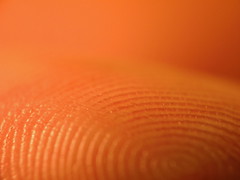
Fingerprints
Creative Commons License photo credit: kevindooley

From Jake Vinson’s “Cracking your Fingers” (The Daily WTF: 28 April 2009):

A few days later, Ross stood proudly in the reception area, hands on his hips. A high-tech fingerprint scanner sat at the reception area near the turnstile and register, as the same scanner would be used for each, though the register system wasn’t quite ready for rollout yet. Another scanner sat on the opposite side of the turnstile, for gym members to sign out. … The receptionist looked almost as pleased as Ross that morning as well, excited that this meant they were working toward a system that necessitated less manual member ID lookups.

After signing a few people up, the new system was going swimmingly. Some users declined to use the new system, instead walking to the far side of the counter to use the old touchscreen system. Then Johnny tried to leave after his workout.

… He scanned his finger on his way out, but the turnstile wouldn’t budge.

“Uh, just a second,” the receptionist furiously typed and clicked, while Johnny removed one of his earbuds out and stared. “I’ll just have to manually override it…” but it was useless. There was no manual override option. Somehow, it was never considered that the scanner would malfunction. After several seconds of searching and having Johnny try to scan his finger again, the receptionist instructed him just to jump over the turnstile.

It was later discovered that the system required a “sign in” and a “sign out,” and if a member was recognized as someone else when attempting to sign out, the system rejected the input, and the turnstile remained locked in position. This was not good.

The scene repeated itself several times that day. Worse, the fingerprint scanner at the exit was getting kind of disgusting. Dozens of sweaty fingerprints required the scanner to be cleaned hourly, and even after it was freshly cleaned, it sometimes still couldn’t read fingerprints right. The latticed patterns on the barbell grips would leave indented patterns temporarily on the members’ fingers, there could be small cuts or folds on fingertips just from carrying weights or scrapes on the concrete coming out of the pool, fingers were wrinkly after a long swim, or sometimes the system just misidentified the person for no apparent reason.

Fingerprint Scanning

In much the same way that it’s not a good idea to store passwords in plaintext, it’s not a good idea to store raw fingerprint data. Instead, it should be hashed, so that the same input will consistently give the same output, but said output can’t be used to determine what the input was. In biometry, there are many complex algorithms that can analyze a fingerprint via several points on the finger. This system was set up to record seven points.

After a few hours of rollout, though, it became clear that the real world doesn’t conform to how it should’ve worked in theory. There were simply too many variables, too many activities in the gym that could cause fingerprints to become altered. As such, the installers did what they thought was the reasonable thing to do – reduce the precision from seven points down to something substantially lower.

The updated system was in place for a few days, and it seemed to be working better; no more people being held up trying to leave.

Discovery

… [The monitor] showed Ray as coming in several times that week, often twice on the same day, just hours apart. For each day listed, Ray had only come the later of the two times.

Reducing the precision of the fingerprint scanning resulted in the system identifying two people as one person. Reviewing the log, they saw that some regulars weren’t showing up in the system, and many members had two or three people being identified by the scanner as them.

A story of failed biometrics at a gym Read More »

Now THAT is fantabulous!

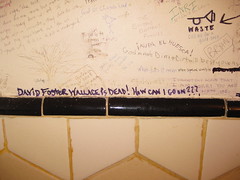
i...dentify
Creative Commons License photo credit: newneonunion

From Roy Kesey’s piece in “Remembering David Foster Wallace” (Edward Champion’s Reluctant Habits: 15 September 2008):

The first story of David’s I ever read was that one Brief Interview that he had in the Paris Review maybe ten or eleven years ago. For me it was paradigm-altering, quietly fantabulous, in exactly the way that having a clay pot broken over your head would be fantabulous if instead of dirt it turned out to be full of cocaine and Slim Jims.

Now THAT is fantabulous! Read More »

A fix for Apple Mail’s inability to search Entire Message

Spotlight
Creative Commons License photo credit: Ti.mo

When using Apple Mail, you should be able to search for a term in From, To, Subject, & Entire Message. However, today I could no longer search Entire Message. It was grayed out & completely unavailable.

I found interesting info on the following pages, with the last being the most helpful:

  • http://discussions.apple.com/message.jspa?messageID=6653445#6653445
  • http://www.bronzefinger.com/archives/2006/04/apple_mail_sear.html
  • http://discussions.apple.com/message.jspa?messageID=5934412#5934412
  • http://forums.macworld.com/message/425508
  • http://www.macosxhints.com/article.php?story=20080201111317585

I closed Mail and tried this, which re-indexes the entire hard drive in Spotlight:

sudo mdutil -E /

But it did nothing. Then I did this, which re-indexes just the Mail folders in Spotlight:

mdimport ~/Library/Mail

That fixed it.

A fix for Apple Mail’s inability to search Entire Message Read More »

What’s wrong with the Republicans


Creative Commons License photo credit: bobster855

From Andrew Sullivan’s “Who Will “Sister Souljah” Them?” (The Daily Dish: 5 May 2009):

… the GOP is poison to me and many others. Why?

Their abandonment of limited government, their absurd spending under Bush, their contempt for civil liberties, their rigid mindset, their hostility to others, their worship of the executive branch, their contempt for judicial checks, their cluelessness with racial minorities and immigrants, their endorsement of torture as an American value, their homophobia, their know-nothing Christianism, and the sheer vileness of their leaders – from the dumb-as-a-post Steele to the brittle, money-grubbing cynic, Coulter and hollow, partisan neo-fascist Hannity.

What’s wrong with the Republicans Read More »