Legend: DA [Dave Alan, Host] AC: [Alex Christopher] C: [Caller]
…
(Note: according to former British Intelligence agent Dr. John Coleman, the London-based Wicca Mason lodges are one-third of the overall global conspiracy. The other two thirds are the Black Nobility banking families who claim direct descent from the early Roman emperors, and also the Maltese Jesuits or the Jesuit – Knights of Malta network. All three networks each have 13 representatives within the Bilderberg organization, which is a cover for the Bavarian Illuminati, suggestive that Bavaria itself has orchestrated a “marriage of convenience” between these three formerly competitive global control groups. – Branton)
…
AC: All right. The information, primarily, that is in “Pandora’s Box” covers how the major corporations, railroad and banking concerns in this country were set up through a ‘trust’ that was originally known as the Virginia Company… The deal was that everything would remain under English control, or subservient to it, and that brings us right up to today, because we are still looking at everything falling under that ‘trust’ system going back to the Crown of England. It is mind boggling to think that everyone in this country has been led to believe that the people in the United States had won independence from England, when in fact they never did.
…
AC: The capstone, or the dedication stone, for the Denver airport has a Masonic symbol on it. A whole group of us went out to the airport to see some friends off and see this capstone, which also has a time capsule imbedded inside it. It sits at the south eastern side of the terminal which, by the way, is called “The Great Hall”, which is what Masons refer to as their meeting hall. And, on this thing it mentions “the New World Airport Commission”. …
AC: It has a Masonic symbol on it, and it also has very unusual geometric designs. It depicts an arm rising up out of it that curves at a 45 degree angle. It also has a thing that looks like a keypad on it. This capstone structure is made of carved granite and stainless steel, and it is very fancy.. This little keypad area at the end of the arm has an out-of-place unfinished wooden block sitting on it. The gentleman that was with me on the first trip out to the airport has since died. They say he committed suicide, but everything else tells me that this is not possible. No one can double-tie a catheter behind his own neck and strangle himself. I just don’t think that is possible. But, his name was Phil Schneider, and he started blowing the whistle on all this stuff going on in the underground bases that he had helped build for years and years. He worked on the underground bases at Area 51 and Dulce, New Mexico, as well as several other places. Schneider told me that this keypad-looking area looked like a form of techno-geometry that is “alien-oriented”, and that it had something to do with a “directional system”, whatever that meant, that functioned as a homing beacon to bring ships right into the “Great Hall”.
…
(Note: … Remember even through the Bilderbergers consist of a “marriage of convenience” between Londonese Wicca Masons, Basilian Black Nobility and Roman Maltese Jesuits… the supreme controllers of the Bildeberger cult itself are the secret black Gnostic cults of Bavaria whose ‘Cult of the Serpent’ — or Illuminati — can be traced back to Egypt and ultimately to Babylon itself. These Rockefeller-Nazi projects reportedly continued through at least 1975 during which period many thousands more “underground Nazis” were brought into America from Europe and also, if we are to believe some reports, from the secret German “New Berlin” base under the mountains of Neu Schwabenland, Antarctica that was established during World War II via Nazi-occupied South Africa. Is Neu Schwabenland the REAL power behind the joint Bavarian-Alien New World Order Agenda? …)
…
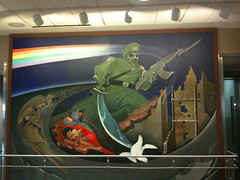
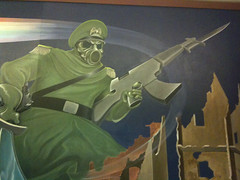
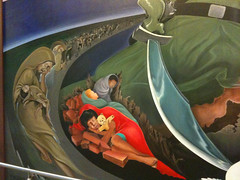
AC: … It took myself and two other people over eight months to figure out all the symbology that is embodied in these murals. It turned out that some of these are ‘trigger’ pictures, containing symbology designed to trigger altered personalities of people that have been groomed in MKULTRA type programs for specific tasks that they have been trained to do in terms of something connected with Satanic rituals and mind control. I had one woman that called me out of the blue one night, and she was really disturbed about some information. She told me many different things that later turned out to be known MKULTRA triggers. Also, almost every aspect of these murals contains symbols relating back to secret societies. When you get the overall view of what they are talking about in these things, it is very very scary. It goes back to the Bio-diversity Treaty, getting rid of specific races of people, taking over the world and mind control.
…
AC: Well, the gentleman that I was dealing with, Phil Schneider, said that during the last year of construction they were connecting the underground airport system to the deep underground base. He told me that there was at least an eight-level deep underground base there, and that there was a 4.5 square mile underground city and an 88.5 square-mile base underneath the airport.
…
DA: You were telling me that there are huge concrete corridors with sprinklers all along the ceiling. What are these sprinkler heads doing in a concrete bunker, pray tell? (Presumably concrete will not ‘burn’ if there is a potential fire, so is it possible that something other than ‘water’ is meant to be expelled from these sprinklers which are located “all along” the ceiling? – Branton)
…
AC: I think a lot of the people saw things that disturbed them so much that they would not talk about it. I know several people who worked on the project that managed to find their way down into the depths, probably close to the deep underground base, and saw things that scared them so badly they won’t talk about it. I interviewed a few of the former employees on these construction crews that worked out there on these buildings that ended up buried, and they are afraid to talk. They say that everybody is real nervous about it, and they decided to tell some of the secrets that they knew, but they don’t want anybody to know who they are. So, I can tell you that it is a very unusual and spooky type of place, and if you are a sensitive person you get nauseated as soon as you enter the perimeter of the airport. Especially when you go down underground. You become very nauseated a nervous. There is also so much electromagnetic flux in the area that if you get out on the open ground around the airport, you will ‘buzz’.
…
AC: If Phil is right, and all this hooks up to the deep underground base that he was offered the plans to build back in 1979, and that what this other man TOLD me in private [is] that there is a lot of human SLAVE LABOR in these deep underground bases being used by these aliens, and that a lot of this slave labor is children. HE SAID that when the children reach the point that they are unable to work any more, they are slaughtered on the spot and consumed.
DA: Consumed by who?
AC: Aliens. Again, this is not from me, but from a man that gave his life to get this information out. He worked down there for close to 20 years, and he knew everything that was going on.
DA: Hmmm. Who do these aliens eat?
AC: They specifically like young human children, that haven’t been contaminated like adults. Well, there is a gentleman out giving a lot of information from a source he gets it from, and he says that there is an incredible number of children snatched in this country.
DA: Over 200,000 each year.
AC: And that these children are the main entree for dinner.
…
AC: Yes. From some information that has been put out by a group or team that also works in these underground bases that is trying to get information out to people that love this country, THERE IS A WAR THAT IS GOING ON UNDER OUT FEET, AND ABOVE OUR HEADS, that the public doesn’t know anything about, and its between these ALIEN forces and the HUMANS that are trying to fight them.
DA: What other types have you seen?
AC: The ones that I have seen are the big-eyed Greys and the Reptilians.
DA: What do these Reptilians look like?
AC: There are three different types.
…
AC: … Anyway, they were both totally flipped out. I finally got them calmed down enough to let me go home. I went home and went to bed. The next thing I know, I woke up and there is this ‘thing’ standing over my bed. He had wrap-around yellow eyes with snake pupils, and pointed ears and a grin that wrapped around his head. He had a silvery suit on, and this scared the living daylights out of me. I threw the covers over my head and started screaming….I mean, here is this thing with a Cheshire-cat grin and these funky glowing eyes…this is too much. I have seen that kind of being on more than one occasion.
DA: What else can you say about it?
AC: Well, he had a hooked nose and he was [humanoid] looking, other than the eyes, and had kind of grayish skin. Later on in 1991, I was working in a building in a large city, and I had taken a break about 6:00, and the next thing I knew it was 10:30 at night, and I thought I had taken a short break. I started remembering that I was taken aboard a ship, through four floors of an office building, and through a roof. There on the ship is were I encountered ‘GERMANS’ AND ‘AMERICANS’ WORKING TOGETHER, and also the GREY ALIENS, and then we were taken to some other kind of facility and there I saw the REPTILIANS again … the one’s I call the “baby Godzilla’s”, that have the short teeth and yellow slanted eyes, and who look like a VELOCI-RAPTOR, kind of.
DA: So, why would these people pick on you?
AC: Well, I found one common denominator in the abduction, and it keeps on being repeated over and over again. I deal with lots of people who have been abducted, and the one common denominator seems to be the blood line, and its the blood line that goes back to ancient Indian or Native American blood lines.
…
AC: Well, at that facility I saw the almond-eyed Greys, but the thing that sticks in my mind are the beings that look like reptiles, or the veloci-raptors. They are the cruelest beings you could ever imagine, and they even smell hideous. There were a couple of very unusual areas down there where I was taken which looked like cold storage lockers, where these things were in hibernation tubes, and that is about all I remember, other than seeing some black helicopters and little round-wing disk type aircraft
…
In the book “Cosmic Conflict”, the author talks about the ancient city that was uncovered by the Germans before World War II, and tells about their effort to revive some frozen humans they found in this underground city, and that the true humans couldn’t be revived, but the ones that could be revived were in fact reptilians in disguise, and the reptilians have the capability to do shape-shifting and create a [laser] holographic image so when you look at them you see a human, but under that there is no human there. … Allegedly the reptilians re-animated and killed the Soviet scientists and through some type of psychic osmosis drained their minds and assimilated their memories and features through a molecular shape-shifting type process. … The alien ‘impostors’ then called for backup and more scientists came out and were ‘replaced’, and these eventually returned to Russia and began to infiltrate the Communist government.
…
AC: These people that have done all this research and are part of the underground government are telling that the humans on this planet have been at war with these reptilian aliens for thousands of years. At one point, things got so hot on the planet, like it is now, aliens took on this holographic image and infiltrated the human race in order to take it over and undermine it, just like this New World Order is doing right now. They’re saying that the same thing happened to civilization on Earth before, and that the humans before actually had the capability for interplanetary travel, and that it was so bad here with the reptilians that they had to leave… What they are also saying is that these beings that are human-looking that are visiting our planet, at this time, trying to inform people what is going on, and guide them, are actually OUR ANCESTORS THAT ESCAPED FROM EARTH before, when it was under reptilian domination.
…
AC: I went to South Florida a couple of weeks ago and interviewed a man who had done research for 30 years, and oddly enough, he tapped into some of the same information I had, in that our government has had round-winged, saucer-type technology, high mach speed aircraft since the 1920’s, and that in 1952 they had over 500 of these aircraft hidden in secret bases. Now, if they had that in 1952, considering that military technology grows by 44 years for every year that goes by, what do you imagine they have now, 44 years later, after technology has advanced the equivalent of 1,936 years?
…
AC: He claims to be one of the ones who jumped overboard off the Eldridge when it went into hyperspace during the Philadelphia Experiment. He actually traveled forward in time, and asked the people that he encountered there what happened in his future. At that time, he was given the information about the New World Order and that Denver was the location for the NWO Western Sector, and that Atlanta was supposed to be the control center for the Eastern Sector. Can it be that the fact that the Olympics is supposed to be in Atlanta is part of a scenario?